Overview
In medical data, the cases that matter most are often the rarest. This study tackles class imbalance in a lung cancer dataset using SMOTE (Synthetic Minority Over-sampling Technique) with a Random Forest classifier, and measures how much balancing the training data actually helps.
Context: Data Mining course research paper, Informatics, Universitas Jenderal Soedirman (June 2024)
Team: 3 people
Tools: Python
Dataset
A Kaggle lung cancer dataset with 309 records and 16 attributes: gender, age, 13 yes/no symptoms and risk factors (smoking, yellow fingers, anxiety, peer pressure, chronic disease, fatigue, allergy, wheezing, alcohol, coughing, shortness of breath, swallowing difficulty and chest pain) and the diagnosis label.
After removing duplicates, 276 records remained: 238 negative and only 38 positive, roughly a 6 to 1 imbalance.
Method
Remove duplicate records
Split the data 80:20 into training and test sets
Apply SMOTE to the training data only, creating synthetic minority samples by interpolating between nearest neighbors
Train Random Forest on both the original and the balanced training set
Evaluate both models on the same untouched test set
Set | Minority class | Majority class |
|---|---|---|
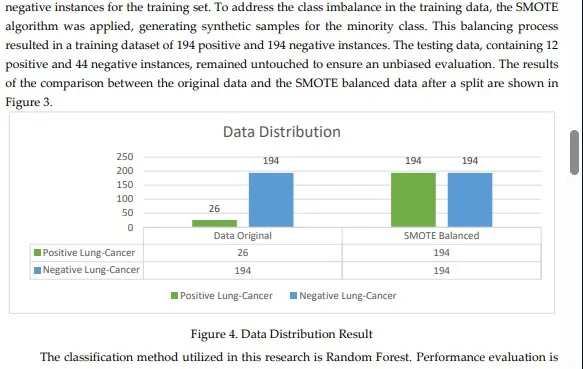
Training, original | 26 | 194 |
Training, after SMOTE | 194 | 194 |
Test, untouched | 12 | 44 |
Results
Metric | Random Forest | Random Forest + SMOTE |
|---|---|---|
Accuracy | 87.5% | 91.1% |
Recall | 88% | 91% |
Precision | 87% | 92% |
F1-score | 86% | 90% |
On the 56-record test set, SMOTE eliminated the only false positive (1 → 0) and caught one more true positive (6 → 7 out of 12).