Overview
Assigning an internship (Kerja Praktik) supervisor often relies on subjective judgment, which can lead to unbalanced lecturer workloads and unhappy students. This project applies Fuzzy Simple Additive Weighting (Fuzzy SAW) to turn that decision into a transparent, ranked recommendation.
Context: Decision Support Systems course project, Informatics, Universitas Jenderal Soedirman (2024)
Team: 3 people
Criteria & Weights
The criteria come from a literature study and are weighted on a fuzzy scale from Very Low (0) to Very High (1).
Code | Criterion | Weight |
|---|---|---|
C1 | Education level | 0.25 |
C2 | Academic rank (jabatan fungsional) | 1.00 |
C3 | Competence in the student's field | 0.50 |
C4 | Supervision quota | 0.75 |
Every sub-category is mapped to a fuzzy value. A doctorate (S3) scores 1.0 and a master's (S2) 0.5. Academic rank runs from Assistant Lecturer (0.25) up to Professor (1.0). For quota, a lecturer with 0 to 5 students scores 1.0, while one with 21 to 25 students scores 0.
How It Works
Rate each of the 5 candidate lecturers (A1 to A5) on every criterion
Build the decision matrix, using competence scores for the student's focus area
Normalize each column; all criteria are benefit attributes, so rij = xij / max(xj)
Multiply by the criterion weights and sum into a preference value V
Rank the candidates from the highest V to the lowest
Result
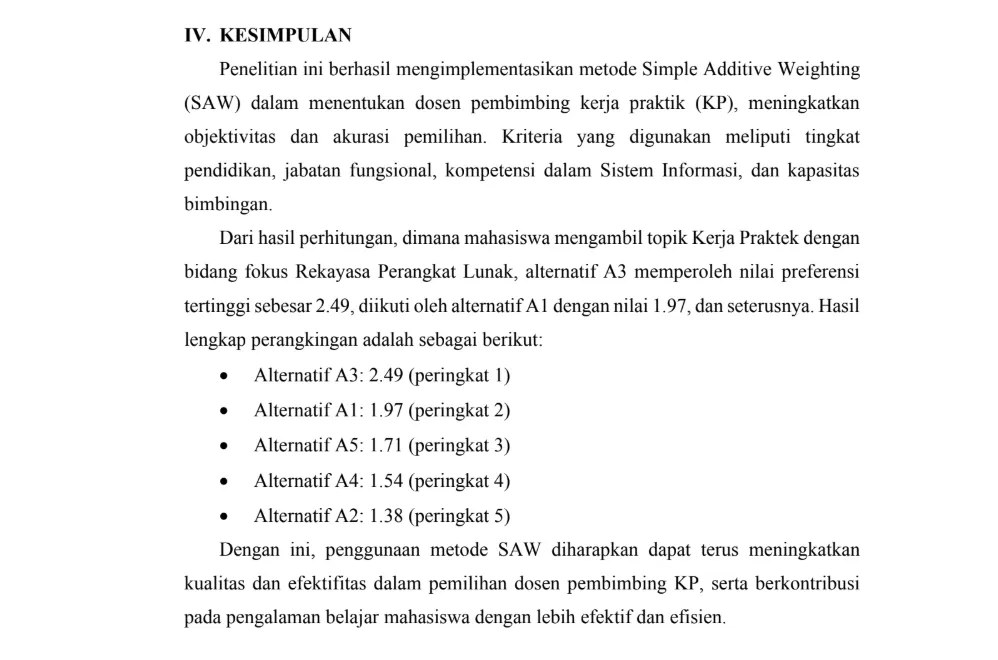
The simulation used a student whose internship focuses on Software Engineering (Rekayasa Perangkat Lunak, RPL).
Rank | Candidate | Preference value |
|---|---|---|
1 | A3 | 2.49 |
2 | A1 | 1.97 |
3 | A5 | 1.71 |
4 | A4 | 1.54 |
5 | A2 | 1.38 |
A3, a Professor with a doctorate and the lightest supervision load among the candidates, came out on top. Interestingly, A2 had the highest Software Engineering competence score (0.90) but ranked last, because a lower academic rank, a master's degree and a heavier quota outweighed that advantage.