Overview
This case study predicts gold price movements (Gold Futures) from daily Yahoo Finance data, 1 January 2015 to April 2025. It answers two questions: will the price go up or down, and what will the next closing price be? The forecast was submitted on 22 April 2025 and checked against the real price on 24 April 2025.
Context: Machine Learning course case study, Universitas Jenderal Soedirman (2025)
Team: Solo
Tools: Python, yfinance, Pandas, scikit-learn, Seaborn, Google Colab
Feature Engineering
Moving Averages over 5, 10, 20 and 50 days
Exponential Moving Averages, which react faster to recent prices
Momentum: today's price compared to an earlier one
Volatility: standard deviation of the price over a window
Calendar features: day, month and day of week
Rows left empty by the rolling windows were dropped, and every feature was standardized with StandardScaler, which matters for a distance-based model like KNN.
Time-Based Split
The data was split chronologically: the oldest 80% (2015 to 2024) for training and the newest 20% (into 2025) for testing, so the models are always evaluated on prices they have never seen.
Model 1: KNN for Direction
A K-Nearest Neighbors classifier predicts whether the next close goes up or down. Odd values of k from 3 to 19 were tested, and k = 19 gave the best accuracy: 89.12%.
Model 2: Linear Regression for Price
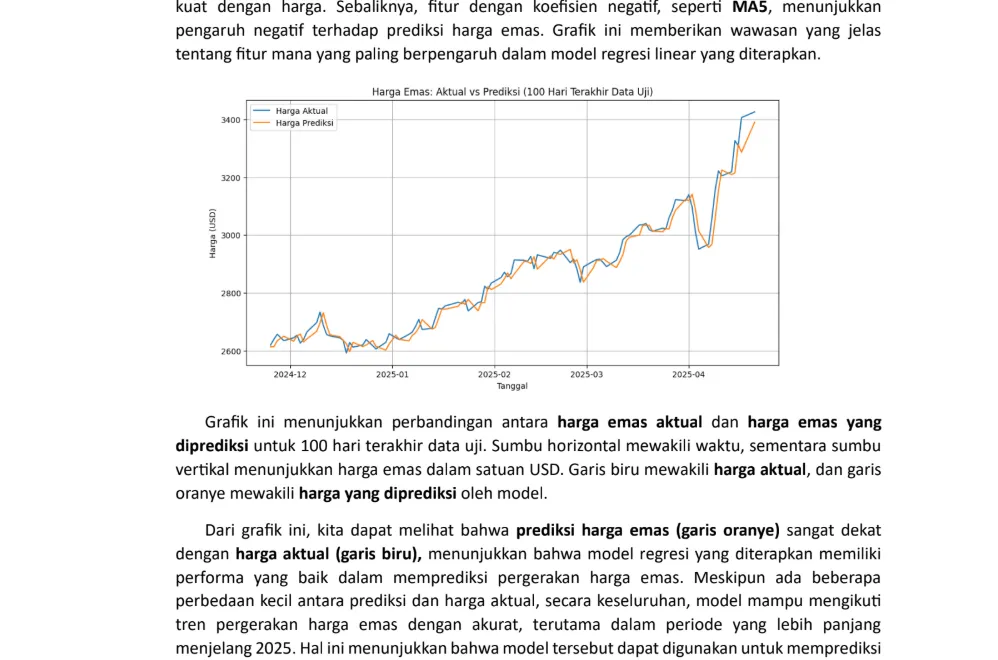
A Linear Regression model predicts the next day's closing price.
Metric | Value |
|---|---|
MAE | $17.37 |
RMSE | $24.02 |
R² | 0.9958 |
Among the coefficients, EMA5 pushes the prediction up strongly, while MA5 has a negative effect.
Forecast for 24 April 2025
Using the last available data point (21 April 2025), the models predicted:
Output | Prediction |
|---|---|
Direction | Up, 100% confidence |
Closing price | $3,405.36 |